How Tides Shape Your Sundarban Private Boat Safari
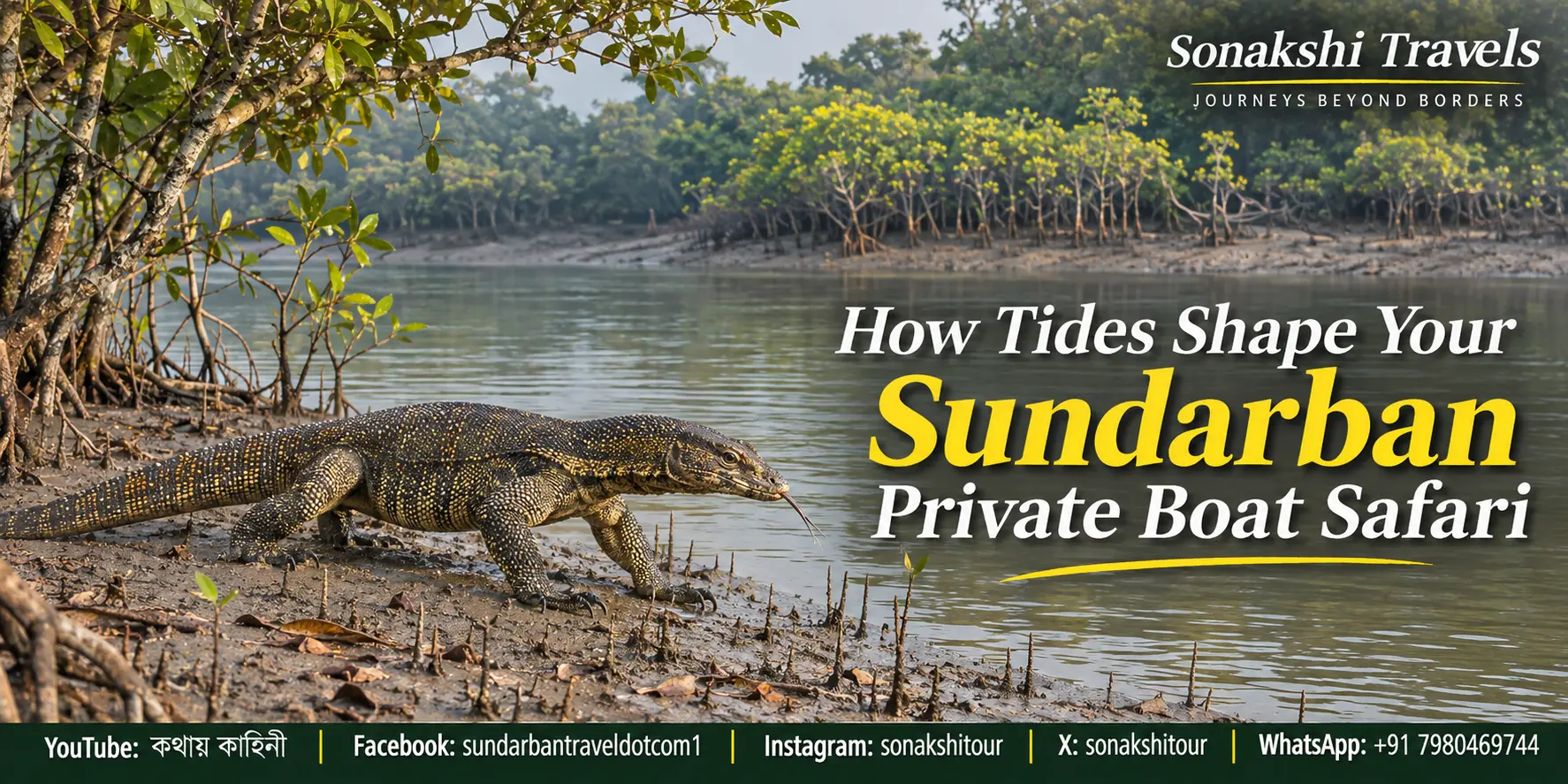
A Sundarban private boat safari is never quite the same journey twice. You may travel along a familiar river, pass the same mangrove-covered banks and visit similar wildlife observation areas, yet the landscape can appear remarkably different depending on the tide. At one moment, exposed mudflats reveal intricate mangrove roots and feeding birds. Several hours later, rising water covers much of the shoreline, changes the appearance of smaller channels and influences how your boat moves through the estuary. Understanding these tidal changes can help you plan a more rewarding private safari.
Unlike destinations where sightseeing mainly depends on roads and fixed attractions, the Sundarbans are shaped by the movement of water. Rivers, creeks, islands and forest margins respond continuously to tidal conditions. This influences not only the scenery but also navigation, photography, wildlife observation and the practical timing of boat journeys.
For travellers considering a private Sundarban safari, the important question is not simply whether high tide or low tide is better. Each phase offers different viewing conditions, and neither guarantees wildlife encounters. A thoughtfully planned private journey considers tidal behaviour alongside weather, authorised tourism routes, forest regulations and your personal interests. This guide explains what those changes mean in practice and how to discuss tide-aware planning with your tour operator.
1. Understanding the Sundarbans’ Tidal Environment
The Indian Sundarbans form part of the wider Ganges-Brahmaputra-Meghna delta system, where numerous waterways connect mangrove islands with larger estuaries and the Bay of Bengal. The landscape is influenced by freshwater discharge, saline and brackish water, sediment movement and repeated tidal flooding.
For visitors, the most noticeable feature is the changing relationship between land and water. A muddy bank that appears wide during one part of the day may be partly submerged later. Mangrove roots can become visible or disappear beneath the surface as water levels change.
Why the Water Rises and Falls
Tides are caused primarily by the gravitational influence of the Moon and Sun, combined with the movement of the Earth. In the Sundarbans, the predominant pattern is semi-diurnal, meaning that two high tides and two low tides generally occur during a lunar day.
The cycle is not identical at every location. Water levels, tidal ranges and current timings vary between river systems, smaller creeks and different parts of the delta.
This distinction matters when planning a safari. A tide table for one coastal location cannot automatically describe the exact water conditions at every watchtower, jetty or inland creek.
High Tide, Low Tide and the Changing Shoreline
During high tide, water rises along the river margins and may cover areas of mud and exposed roots. Some smaller tidal channels hold deeper water, while the visible shoreline becomes narrower.
At low tide, water retreats from many banks, revealing mudflats, sediment deposits and portions of the mangrove root system. Shallow margins become more prominent, and smaller waterways may have reduced navigable depth.
The change can substantially alter the character of the same stretch of river. Visitors may see a broad water-filled channel during one passage and a more detailed muddy shoreline during another.
Why Tidal Currents Are as Important as Water Height
Water height is only one consideration. Tides also generate currents as water moves into and out of the estuarine network.
The incoming or flood tide moves water landward through the channels, while the outgoing or ebb tide carries water back towards lower levels. Local current strength depends on channel shape, tidal range, river discharge and other conditions.
A strong current can influence boat handling, travel time and the comfort of passengers. The boat driver must evaluate these circumstances rather than relying only on the scheduled time of high or low water.
2. How High Tide Changes Your Private Boat Safari
High tide can transform the appearance of the Sundarbans. Rising water covers parts of the muddy banks, bringing the river visually closer to the vegetation and creating a more continuous water-and-forest landscape.
For travellers who enjoy wide waterways and observing the mangrove canopy, this can be an attractive phase of the tidal cycle.
A Different Perspective on the Mangrove Forest
At higher water levels, some exposed roots and mudflats disappear beneath the river surface. Branches and lower vegetation may appear nearer to the water, producing a distinctive view of the forest edge.
From the boat, the experience may feel more immersive because the visible division between land and water is less pronounced.
This can be particularly interesting for landscape photography. Reflections, overhanging vegetation and the shapes of tidal channels provide opportunities for compositions that differ from low-water photographs.
Water Depth and Navigable Channels
Higher water levels can increase the available depth in some smaller tidal waterways. However, this does not mean every creek becomes accessible or safe.
Submerged obstructions, strong currents, channel geometry and forest restrictions may continue to limit navigation. A boat’s draft, size and operating permissions also matter.
A private booking does not authorise travel through a restricted creek merely because the water is deep enough.
Experienced boat crews consider both the physical navigation conditions and the rules governing the proposed route.
Wildlife Observation During Higher Water
During high tide, some animals may use slightly different parts of the shoreline or forest edge as water covers lower ground.
However, wildlife movements are influenced by numerous factors beyond tidal height, including disturbance, food availability, weather, habitat and the behaviour of individual animals.
It would therefore be misleading to claim that high tide always produces better tiger, crocodile or deer sightings.
For visitors, the most useful approach is to remain observant and allow the guide to interpret the conditions without expecting a particular animal to appear.
3. How Low Tide Reveals Another Side of the Sundarbans
Low tide can be especially interesting for travellers who enjoy studying the structure of mangrove habitats. As water recedes, more of the riverbank becomes visible, revealing sediments, exposed roots and feeding areas used by different species.
The landscape may appear less like an uninterrupted forest-lined river and more like a complex network of mud, water and vegetation.
Exposed Mudflats and Mangrove Roots
One of the most distinctive low-tide sights is the appearance of mangrove root systems. Depending on the species and location, pencil-like pneumatophores, spreading roots and other specialised structures may become visible above the mud.
These adaptations help mangrove plants survive in waterlogged, oxygen-poor conditions.
For nature enthusiasts, seeing the exposed root environment can provide a clearer understanding of why the Sundarbans are unlike ordinary inland forests.
Low water also reveals the patterns left by tidal movement across muddy banks. Small channels, sediment ridges and wet surfaces create intricate textures that can be rewarding photographic subjects.
Opportunities for Birdwatching
Some shoreline-feeding birds take advantage of exposed mud and shallow water to search for food. Depending on season and location, visitors may observe waders, herons, kingfishers and other birds around suitable river margins.
Low tide can therefore create interesting birdwatching conditions, particularly where previously submerged feeding areas become accessible.
Nevertheless, bird activity does not follow a single universal schedule. Species differ in their feeding behaviour, and the presence of suitable habitat does not guarantee a sighting.
Ask your guide to explain which birds are likely to use the particular stretch of river rather than assuming that every mudflat will be active.
Crocodiles and Exposed Banks
Saltwater crocodiles inhabit the Sundarbans and may sometimes be observed resting on exposed banks or using shallow waters.
Low tide can reveal potential basking areas that are submerged at other times. However, crocodile activity depends on temperature, disturbance, individual behaviour and local conditions.
There is no reliable rule that a visitor will see a crocodile simply because the river is at low water.
Observation must take place from a safe distance under the guidance of the authorised crew. Approaching crocodiles closely or attempting to influence their behaviour is inappropriate and potentially dangerous.
Navigation Limitations at Low Water
The same low water that reveals fascinating habitat details can restrict navigation.
Shallow channels, exposed shoals and reduced clearance may prevent a boat from proceeding through certain areas safely. Larger boats may require more water depth than smaller vessels, although all must follow authorised routes.
The driver may need to adjust the speed, route or timing based on the available depth and current.
Consequently, low tide should not be treated as automatically preferable for every private safari.
4. High Tide Versus Low Tide: Which Is Better for a Sundarban Safari?
Travellers often ask whether they should specifically request a high-tide or low-tide safari. The most useful answer depends on what they hope to experience.
Neither phase is universally superior. The following comparison highlights the practical differences.
| Safari consideration | Higher water | Lower water |
|---|---|---|
| Mangrove scenery | Water appears closer to the vegetation | More mud and root structures become visible |
| Shoreline photography | Useful for water reflections and forest-edge compositions | Useful for mudflat textures and exposed roots |
| Bird observation | May offer views of perched and water-associated birds | May expose feeding areas for some shorebirds |
| Crocodile observation | Animals may be in water or along available banks | Additional exposed resting areas may be visible |
| Small-channel navigation | Greater depth in some channels | Reduced clearance in some channels |
| Currents | Depend on tidal phase and location | Depend on tidal phase and location |
| Tiger sightings | Not guaranteed | Not guaranteed |
Choose According to Your Main Interest
If your primary interest is mangrove ecology, exposed roots and shorebird feeding areas, a period of lower water may offer particularly interesting observations.
If you prefer reflections, broad water views and the appearance of vegetation close to the river surface, higher water may be visually appealing.
Wildlife photographers may value both, since different subjects and backgrounds become available throughout the tidal cycle.
Rather than choosing a safari solely around one tidal phase, consider requesting an itinerary that allows meaningful observation under more than one condition, where practical and permitted.
Why Timing Alone Cannot Guarantee Success
Tides influence habitat visibility, but wildlife sightings also depend on chance, animal behaviour, weather, seasonal conditions and the route used.
A technically favourable low-tide period may coincide with poor visibility or little wildlife activity. A high-tide journey may still produce excellent bird observations.
Good safari planning therefore involves understanding multiple variables rather than searching for a single perfect tide.
5. The Relationship Between Tides, Boat Navigation and Safari Timing
The Sundarbans require careful navigation because river conditions are continuously changing. A private tour operator must coordinate the desired sightseeing programme with practical boating limitations and forest access rules.
Why Departure Time Is Not Based on Tides Alone
A tour’s departure schedule depends on several considerations, including the boarding point, road transfer, permit procedures, available daylight and expected return time.
Tide timing may influence operational decisions, particularly where shallow water or strong currents affect boarding and navigation.
However, a tidal forecast does not override forest entry restrictions or provide permission to extend a trip after authorised visiting hours.
Ask the operator how the intended schedule has been coordinated rather than requesting an arbitrary departure time based only on a tide table.
Tidal Currents and Boat Speed
Even where sufficient water depth is available, currents can influence the movement of a boat.
Travelling with or against a current may affect progress, fuel consumption and the driver’s handling decisions. The effect varies with channel geometry, water movement and vessel characteristics.
For passengers, this means that estimated travel durations should be treated as approximate rather than guaranteed.
A well-managed private safari allows reasonable operational margins instead of promising that every location will be reached at an exact minute.
River Crossings and Boarding Arrangements
Tidal water levels may also influence how passengers board and leave the vessel.
Jetty steps, gangplank angles and the relative height of the boat and landing can change. Crew assistance and appropriate footwear may be important, especially for travellers with limited mobility.
Before booking, explain any particular boarding concerns to the operator.
A private arrangement can improve coordination, but it cannot remove every physical challenge associated with a tidal river environment.
Why the Boat Driver’s Judgement Matters
Online tide predictions can be useful for general planning, but they do not replace the local knowledge and operational judgement of an experienced boat driver.
The crew must consider real conditions, including changing water depth, visibility, current strength, weather and any instructions issued by the relevant authorities.
Visitors should not pressure the driver to take an unsuitable route or maintain an unsafe speed merely to meet a sightseeing expectation.
6. How Tides Influence Wildlife Photography in the Sundarbans
For wildlife photographers, tides affect not only the possible location of animals but also the appearance of backgrounds and the accessibility of observation positions.
Understanding these differences can help photographers prepare more effectively without assuming that any particular animal will be visible.
Low-Tide Photography: Texture, Roots and Shoreline Activity
During lower water, the exposed mud offers contrasting textures against the green mangrove vegetation. Patterns of wet sediment, root structures and shallow channels can create strong environmental photographs.
Birds searching for food along exposed margins may also provide interesting subjects when viewed from an appropriate distance.
However, wide mudflats can leave wildlife far from the boat. A telephoto lens may be useful, and photographers should avoid encouraging the crew to approach animals too closely.
High-Tide Photography: Reflections and Forest Edges
Higher water levels can offer different compositions. Reflections may become more prominent, while partially submerged roots and vegetation produce an alternative view of the mangrove environment.
The quality of reflections depends on wind, current, light and surface movement. High tide alone does not guarantee calm water.
Photographers should consider the combined effect of sunlight, boat motion and the position of the subject when choosing camera settings.
Combine Tidal Planning With Natural Light
Early morning and late afternoon light may provide attractive photographic conditions, but these periods do not always coincide with the desired tidal phase.
Because tidal timing shifts from day to day, photographers should check the relevant date rather than assume that low tide always occurs in the morning.
If photography is your main purpose, discuss your preferred subjects and available travel dates with the operator.
The objective should be a realistic opportunity for observation, not a promise that an animal will appear under ideal lighting.
7. Why a Private Boat Can Help With Tide-Aware Safari Planning
A private Sundarban boat safari does not provide control over the tides, but it can give travellers more influence over certain aspects of their itinerary.
This distinction is particularly relevant for photographers, experienced nature enthusiasts and families who want a comfortable, thoughtfully coordinated journey.
More Personalised Discussion With the Guide
On a private tour, travellers can communicate their interests directly to the guide and crew without needing to accommodate the preferences of a large unrelated group.
For example, visitors interested in mangrove ecology may want explanations of exposed roots and tidal mudflats. Birdwatchers may prefer to spend more time observing suitable shoreline habitats.
These interests can inform planning within the permitted itinerary, subject to available time and operational conditions.
The guide remains responsible for following forest rules, and the boat driver retains authority over navigation and safety.
Choose a Suitable Boat and Itinerary
Boat selection can affect the practical experience of changing tidal conditions.
Ask about the vessel’s passenger capacity, seating, observation areas, toilet facilities and suitability for the proposed route.
Do not assume that a smaller boat can legally enter every narrow creek or that a larger boat will always provide greater comfort.
The appropriate vessel depends on the authorised route, operating conditions and the facilities required by your group.
Greater Flexibility Does Not Mean Unlimited Freedom
Private travel may offer additional freedom over meals, seating preferences and the coordination of available sightseeing time.
However, it cannot change the natural tidal cycle or override protected-area regulations.
Visitors must remain within authorised tourist routes and follow instructions concerning stopping, disembarking and permitted operating hours.
The strongest private-tour experience combines reasonable personalisation with realistic expectations and responsible navigation.
8. Advantages and Limitations of Planning Around the Tides
Understanding tidal behaviour can improve travel preparation, but tide-aware planning has both benefits and limitations.
Advantages
- Better landscape understanding: Travellers recognise why mangrove banks appear different throughout the day.
- More informed photography: High and low water offer different compositions and shoreline details.
- Improved practical planning: Discussions about navigation and boarding become more realistic.
- Greater appreciation of ecology: Tidal flooding helps explain the distinctive adaptations of mangrove vegetation.
- More informed safari expectations: Visitors understand why changing water levels can alter viewing conditions.
- Better communication: Travellers can discuss interests with their operator without making unrealistic requests.
Limitations
- No wildlife guarantees: A favourable tide does not ensure sightings of tigers, crocodiles or other animals.
- Variable local conditions: Tidal timing and range differ across the delta.
- Operational restrictions: Forest permits and authorised routes remain binding.
- Weather influences: Wind, rainfall, storms and river discharge may affect water conditions.
- Uncertain observation conditions: Wildlife behaviour cannot be predicted solely from a tide table.
- Limited schedule flexibility: A preferred tide may not coincide with the available legal sightseeing window.
The value of tide-aware planning is therefore practical rather than absolute. It helps travellers understand the destination and make better choices without creating false certainty.
9. Practical Checklist for Booking a Tide-Aware Private Safari
Before confirming your Sundarban private boat tour, use the following checklist to evaluate the proposed arrangements.
Questions About Tides and Navigation
- Which river gateway will be used for boarding?
- Does the itinerary involve waterways where low water can restrict navigation?
- How does the operator consider tidal conditions when planning the journey?
- Are the expected departure and return times realistic?
- Who makes navigation decisions if conditions change?
- Will the itinerary remain within authorised forest routes?
Questions About Wildlife Observation
- Which authorised areas are included in the safari?
- Will a knowledgeable guide explain mangrove ecology and wildlife habitats?
- Are there opportunities to observe exposed mudflats where relevant?
- Can photography interests be discussed before departure?
- Are wildlife sightings clearly described as unpredictable?
Questions About Boat Comfort
- Is the passenger boat reserved for the private group?
- Does the vessel provide sheltered seating?
- Are toilet and drinking-water facilities available?
- Is suitable safety equipment provided?
- How are boarding arrangements managed at different water levels?
- What happens if weather or currents require an itinerary adjustment?
Questions About the Complete Package
- Does the quotation include permits and guiding services?
- Are transport and boat transfers included?
- What meals and refreshments are provided?
- Are accommodation and room categories clearly identified?
- What are the cancellation and rescheduling terms?
- Will operational changes create any additional charges?
Receiving clear answers before payment can help prevent disagreements later. It also provides a more reliable indication of the operator’s understanding of the destination.
10. Choosing the Right Private Safari for Different Travellers
Tidal conditions matter to every visitor, but the practical importance varies according to the type of journey being planned.
Wildlife Photographers and Birdwatchers
Travellers who want to photograph shoreline birds, crocodiles or mangrove habitats may benefit from discussing tidal conditions in advance.
A photographer interested in exposed mudflats may favour different conditions from someone hoping to capture reflections along a forest-lined channel.
Even so, a realistic photography itinerary should account for weather, daylight, authorised routes and the unpredictable presence of wildlife.
Families and Older Travellers
Families may be more concerned with boarding comfort, sheltered seating and manageable travel durations than with photographing a particular tidal phase.
For older travellers, changing water levels can influence jetty access and boat-boarding arrangements. Discuss mobility requirements with the operator before booking.
The most suitable itinerary balances comfort, safety and sightseeing rather than trying to achieve a theoretically perfect wildlife-viewing schedule.
Couples Seeking a Quiet River Experience
For couples, the appeal of private boating often lies in personal space, comfortable seating and the opportunity to enjoy nature without the pressure of a large tourist group.
The changing tides add another dimension to the experience. Exposed roots, reflections and shifting riverbanks can make the scenery feel different over the course of the journey.
Couples interested in this more relaxed approach can explore a couple’s guide to a quiet private Sundarban escape from Kolkata, which discusses private boat arrangements, accommodation choices and practical planning for two travellers.
Whatever the purpose of the trip, the itinerary should reflect the travellers’ actual interests rather than promising that a particular tidal condition will deliver a specific sighting.
11. Common Mistakes When Planning a Sundarban Safari Around Tides
Several misconceptions can lead visitors to make unrealistic booking decisions.
Assuming Low Tide Always Means Better Wildlife
Low tide exposes mudflats and may provide observation opportunities for some shoreline-feeding species. However, other animals may be difficult to see, and activity differs across habitats.
There is no dependable rule that low water guarantees more sightings.
Assuming High Tide Makes Every Creek Accessible
Higher water can increase depth in some channels, but navigation still depends on channel conditions, boat characteristics and forest permissions.
Protected-area restrictions apply regardless of water level.
Using an Unrelated Tide Table
Tidal predictions differ between locations. A forecast for a distant coastal port may not accurately describe the exact timing of high water at a particular inner-delta creek.
Use location-relevant predictions and discuss their interpretation with an experienced local operator.
Expecting a Fixed Tide at a Fixed Clock Time
Tidal phases shift from day to day. A visitor should not assume that the same hour will always correspond to high or low water.
Check the relevant date when planning a journey around a specific tidal condition.
Ignoring Weather and Safety
Even a suitable tidal prediction cannot eliminate the effects of storms, poor visibility or difficult river conditions.
The crew’s operational assessment must take priority over sightseeing preferences.
Frequently Asked Questions About Sundarban Safari Tides
Is high tide or low tide better for a Sundarban private boat safari?
Neither is universally better. Higher water can produce attractive river and forest-edge views, while lower water exposes mudflats and mangrove roots that may interest photographers and birdwatchers. Wildlife observations depend on many factors beyond the tide.
How many times do tides change in the Sundarbans each day?
The predominant tidal pattern is semi-diurnal, generally involving two high tides and two low tides during a lunar day. Exact timing, height and current behaviour vary across the delta and from date to date.
Can I choose my private safari according to the tide timetable?
You can discuss relevant tidal predictions with your operator, but the final itinerary must also account for authorised forest visiting hours, permits, boarding arrangements, navigation conditions and weather. A particular tidal phase cannot always be accommodated.
Does low tide improve crocodile sightings?
Lower water may expose banks where crocodiles sometimes rest, but sightings are not guaranteed. Crocodile presence and behaviour depend on temperature, habitat, disturbance and other conditions. Observe only from safe, authorised positions.
Can private boats enter narrow creeks during high tide?
Higher water may improve depth in certain channels, but that does not create permission to enter them. Only authorised tourist routes may be used, and navigation decisions depend on the boat, current conditions and applicable restrictions.
Do tides affect the chances of seeing a Royal Bengal tiger?
Tides influence shoreline conditions and habitat accessibility, but they cannot predict when or where a tiger will appear. Tiger sightings remain unpredictable, and no responsible tour operator should guarantee them based on tidal timing.
Let the Tides Improve Your Understanding, Not Dictate Your Expectations
The Sundarbans are remarkable because water continually reshapes the visitor’s view of the landscape. Rising tides cover parts of the muddy shoreline, while falling tides reveal roots, sediments and feeding areas that would otherwise remain hidden. These changes influence navigation, photography, wildlife observation and the practical organisation of a private boat safari.
Understanding the tides can help you appreciate the mangrove ecosystem and ask more informed questions before booking. It can also explain why two journeys along similar waterways may produce very different experiences.
However, the best Sundarban safari is not necessarily one scheduled around a particular high or low tide. It is a journey that combines knowledgeable guiding, safe boating, authorised routes, reasonable comfort and realistic wildlife expectations.
Choose a private safari operator who understands local river conditions, communicates clearly and plans responsibly. When tidal awareness supports the journey rather than creating unrealistic promises, your time in the Sundarbans becomes more informative, comfortable and rewarding.