College Street Book Stalls:
An Immersive Journey Through India’s Living Republic of Books
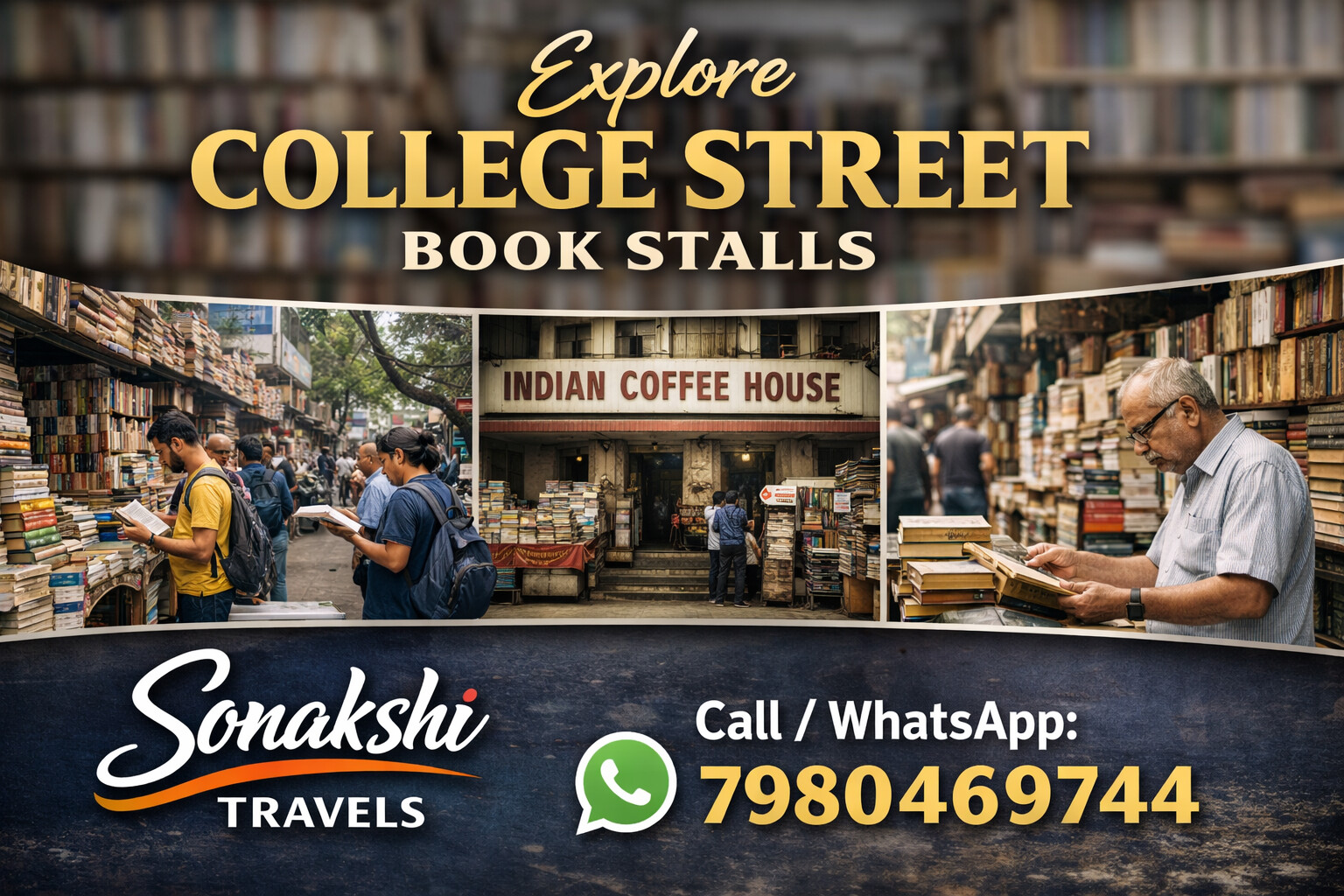
In the intellectual geography of India, few places command the reverence, nostalgia, and cultural weight carried by the book stalls. More than a marketplace, College Street is an ecosystem—one where paper breathes, ink speaks, and ideas change hands across generations. Walking through this long, animated stretch in North Kolkata is not merely an act of shopping for books; it is an initiation into a centuries-old dialogue between scholarship, rebellion, creativity, and public life.
This article is written from the perspective of a field traveler and cultural researcher, observing College Street not as a casual visitor but as a living archive. The following exploration presents a deeply researched, experiential, and practical guide to understanding the book stalls of College Street—their history, rhythms, cultural role, and relevance in contemporary India.
Understanding College Street as a Destination
College Street is a roughly 1.5-kilometre-long arterial road in central-northern Kolkata, running parallel to Bidhan Sarani. It is globally acknowledged as one of the largest second-hand book markets in the world. Unlike formal book districts in Europe or East Asia, College Street evolved organically—shaped by students, printers, freedom fighters, academics, and publishers over more than two centuries.
The street derives its name from the concentration of educational institutions established during the British colonial period. The presence of Presidency College (now Presidency University), Calcutta University, Sanskrit College, Medical College, and numerous schools transformed the area into an academic nucleus. Books followed students, and stalls followed books.
Why the Book Stalls Matter
The book stalls are not peripheral vendors; they are the core identity of College Street. Spread across pavements, temporary sheds, and permanent shops, these stalls collectively house millions of titles—new, used, rare, pirated, out-of-print, annotated, and sometimes anonymous. For decades, these stalls have functioned as informal libraries for those who could not afford formal access to knowledge.
Historical Evolution of the Book Market
The roots of College Street’s book culture can be traced back to the late 18th and early 19th centuries, coinciding with the Bengal Renaissance. As printing presses multiplied in colonial Calcutta, so did demand for textbooks, philosophical treatises, political pamphlets, and literary journals. Vendors began setting up makeshift stalls near colleges, selling both imported British texts and locally printed Bengali works.
During the Indian freedom movement, College Street became a silent collaborator. Revolutionary literature, banned political essays, and underground publications circulated discreetly through trusted booksellers. Many stall owners were themselves politically conscious individuals who understood the power of printed words.
Post-Independence Expansion
After 1947, the expansion of public education in West Bengal dramatically increased student populations. College Street responded by diversifying. Engineering manuals, medical guides, law commentaries, Marxist theory, French philosophy, Russian literature, and vernacular fiction all found shelf space—often stacked vertically, horizontally, and sometimes precariously.
A Walking Exploration of the Book Stalls
The best way to understand College Street is on foot. The experience unfolds slowly, requiring patience, curiosity, and a willingness to browse without urgency.
Northern Stretch: Academic Foundations
Near Mahatma Gandhi Road crossing, stalls predominantly cater to academic needs. Medical textbooks, engineering reference materials, competitive exam guides, and university syllabi dominate this zone. Many books here are older editions—still valued for conceptual clarity despite curricular updates.
Central Stretch: Literature and Philosophy
Moving southward, the market shifts tone. Bengali literature—Tagore, Bankim Chandra, Sarat Chandra—appears alongside translated Russian classics, French existentialists, and Latin American fiction. It is common to find handwritten notes in margins, revealing previous readers’ intellectual journeys.
Southern Stretch: Rare and Second-Hand Finds
Closer to Bowbazar, stalls specialize in rare, antiquarian, and out-of-print works. These sellers often possess encyclopedic memory—able to recall whether a title exists within their stacks without digital assistance.
Cultural and Social Significance
College Street is not merely commercial. It is deeply social. Conversations here range from exam stress to political theory, from poetry to public policy. Students debate prices as passionately as ideologies.
The street has also served as an equalizer. Regardless of economic background, anyone can access knowledge here. A used book costing a fraction of its original price can shape a student’s academic future.
The Role of Coffee Houses
Intellectual exchanges often spill into nearby coffee houses, most famously the historic Indian Coffee House. These spaces function as extensions of the book market—where purchased ideas are debated, contested, and refined.
Best Time and Season to Visit
The ideal season to explore College Street is between October and February. Winter months in Kolkata offer pleasant temperatures, making long walks comfortable. Academic sessions are also in full swing, ensuring the market operates at peak diversity.
Early mornings (10:30 AM to 1 PM) are best for serious collectors, while late afternoons provide a more animated, culturally immersive atmosphere.
Ideal Duration for Exploration
A meaningful visit requires at least half a day. For researchers, students, or bibliophiles, a full day allows deeper engagement—time to compare editions, negotiate thoughtfully, and consult stall owners.
Route and Accessibility
College Street is easily accessible via Kolkata Metro. The nearest stations are Central and Mahatma Gandhi Road. Numerous bus routes connect the area to all parts of the city.
Visitors exploring Kolkata more broadly often combine a College Street walk with heritage circuits, museums, and riverfronts. Those planning extended travel in West Bengal frequently integrate cultural stops with nature-based itineraries such as the Sundarban Travel routes or thematic events like the Sundarban Hilsa Festival, reflecting the state’s diverse intellectual and ecological landscapes.
Practical Insights for Visitors
Negotiation and Etiquette
Bargaining is customary but should be respectful. Many vendors price books based on rarity and demand. Demonstrating genuine interest often results in fairer pricing.
Quality Assessment
Check bindings, missing pages, and print quality. Older editions may have yellowed pages but often retain superior content clarity.
Language Diversity
While Bengali and English dominate, Hindi, Urdu, and foreign-language texts are also available. Scholars researching regional studies often discover unexpected finds.
College Street in the Digital Age
Despite online retail, College Street has not diminished. Instead, it has adapted. Many sellers now fulfill academic reading lists that online platforms cannot supply, especially discontinued editions. Physical browsing remains irreplaceable.
This resilience mirrors broader travel trends where experiential destinations retain value alongside digital convenience—similar to how curated journeys like Sundarban Luxury Tour offerings coexist with mass tourism.
College Street as a Living Archive
Every book stall here functions as a micro-archive. Collectively, they form one of the largest decentralized knowledge systems in Asia. Unlike museums, this archive is interactive—books are touched, read, debated, and carried away to shape new minds.
Travelers exploring India’s intellectual heritage should view College Street not as a stop, but as a study. Much like thematic explorations that link culture with ecology—such as journeys through the Sundarbans detailed at https://sundarbantravel.com/sundarban-tour/—College Street reveals how environments shape thought.
Why College Street Endures
College Street endures because it serves a fundamental human need—the need to learn, question, and connect. It resists commercialization not through isolation, but through relevance. In an era of fleeting digital content, the permanence of printed knowledge finds sanctuary here.
For the serious traveler, College Street is not optional. It is essential. To walk its length is to walk through the intellectual bloodstream of Kolkata—where books are not commodities, but companions.