Jorasanko Thakur Bari:
A Scholarly Exploration of the Tagore Ancestral Home in North Kolkata
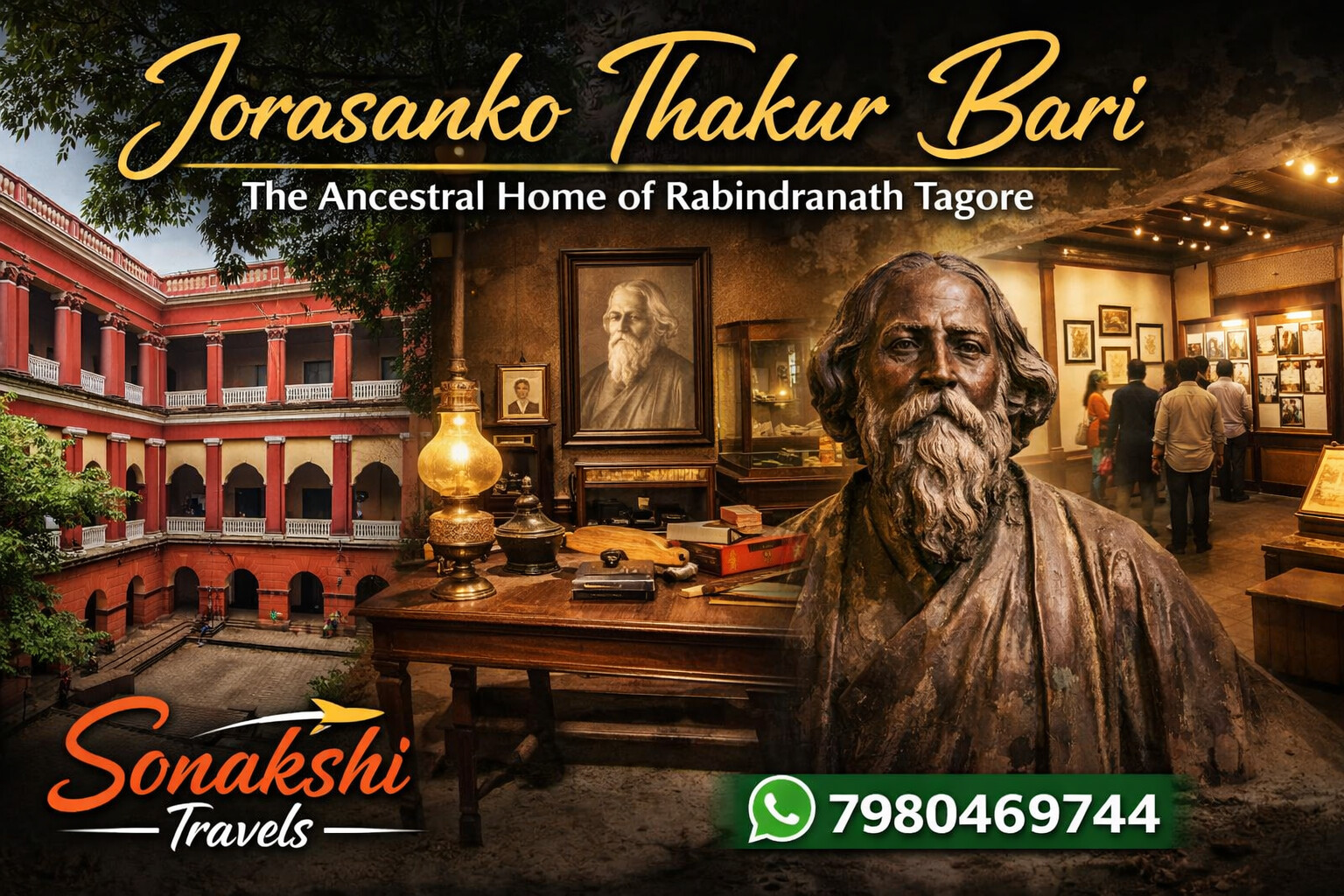
Jorasanko Thakur Bari stands not merely as a heritage building but as a living archive of Bengal’s intellectual, cultural, and socio-political awakening. Located in the dense, historic quarters of North Kolkata, this ancestral mansion of the Tagore family represents a pivotal nucleus of the Bengal Renaissance. To walk through its courtyards and corridors is to trace the evolution of modern Indian thought, literature, music, education, and reformist ideology.
This in-depth exploration approaches Jorasanko Thakur Bari as a destination of layered meanings—architectural, historical, cultural, and experiential—offering the discerning traveler a research-oriented understanding rather than a superficial sightseeing narrative.
Destination Overview: Understanding Jorasanko Thakur Bari
Situated in the Jorasanko neighborhood of North Kolkata, Jorasanko Thakur Bari was established in the late 18th century by Prince Dwarkanath Tagore, one of the earliest Indian industrialists and social reformers under British colonial rule. Over time, the house expanded into a sprawling complex of courtyards, residential quarters, performance spaces, and inner sanctums, reflecting the evolving needs of a family deeply engaged with art, education, and public life.
The mansion gained global recognition as the birthplace and formative home of Rabindranath Tagore, Asia’s first Nobel laureate in Literature (1913). However, the significance of Jorasanko extends well beyond Rabindranath alone. It served as the intellectual headquarters of a family that shaped journalism, theater, painting, music, women’s education, and nationalist discourse in colonial Bengal.
Today, the heritage complex functions as a public museum and academic institution under Rabindra Bharati University, preserving manuscripts, artworks, personal artifacts, and architectural elements that collectively narrate nearly two centuries of Bengali cultural history.
Historical Context and the Tagore Legacy
The Rise of the Tagore Family
The Tagores emerged as one of the most influential zamindar families of Bengal during the late Mughal and early British periods. Dwarkanath Tagore’s entrepreneurial ventures—spanning coal mining, shipping, banking, and tea plantations—provided the financial foundation that enabled the family’s extraordinary patronage of art and education.
Unlike many contemporaneous elites, the Tagores actively engaged with Western education while retaining deep roots in Indian philosophical traditions. This synthesis became the ideological backbone of the Bengal Renaissance, with Jorasanko Thakur Bari acting as its principal incubator.
Rabindranath Tagore and the House of Ideas
Rabindranath Tagore was born here in 1861, and the house profoundly shaped his worldview. Within its walls, he encountered Sanskrit scriptures, Upanishadic philosophy, Western literature, and experimental music. Family-led literary salons, musical rehearsals, and philosophical debates were regular occurrences, making Jorasanko less a residence and more an intellectual ecosystem.
Many of Tagore’s early poems, songs, and essays were conceived in this environment. The ethos of creative freedom that defined his later educational experiments at Santiniketan can be traced directly to the cultural climate of Jorasanko.
Architectural Character and Spatial Design
Traditional Bengali Courtyard Architecture
Jorasanko Thakur Bari exemplifies the traditional Bengali “thakur bari” architectural form, characterized by multiple courtyards (uthans), thick brick walls, high ceilings, and long verandahs. The layout reflects a balance between privacy and community life, with separate zones for family residence, ceremonial gatherings, and artistic pursuits.
The courtyards served functional and symbolic purposes—facilitating ventilation in humid climates while also acting as communal spaces for performances, rituals, and festivals.
European Influences and Colonial Adaptations
As the Tagores interacted with European intellectual circles, architectural elements such as classical columns, arched windows, and ornamental railings were gradually incorporated. These features illustrate the family’s openness to global aesthetics without abandoning indigenous design principles.
The resulting structure stands as a physical metaphor for cultural dialogue rather than cultural replacement.
Key Attractions and Highlights Within the Complex
Rabindranath Tagore Memorial Museum
The museum occupies a significant portion of the ancestral home and displays manuscripts, letters, first-edition books, paintings, and personal belongings of Rabindranath Tagore. These artifacts provide invaluable insight into his creative process, political thought, and personal life.
Birth Room of Rabindranath Tagore
Preserved with restraint and authenticity, the poet’s birth room offers a contemplative space rather than a theatrical display. Visitors often describe it as one of the most emotionally resonant corners of the complex.
Performance Courtyards and Festival Spaces
Jorasanko was a cradle of Bengali theater and music. Courtyards hosted early experiments in stage drama, dance-dramas, and musical compositions that later evolved into Rabindra Sangeet. These spaces continue to host cultural programs during major festivals.
Cultural and Intellectual Significance
Jorasanko Thakur Bari functioned as an alternative university long before institutional higher education was accessible to Indians. Women of the Tagore household received advanced education here, challenging prevailing social norms. Journals, newspapers, and reformist tracts were conceptualized within its walls.
The house played a silent yet decisive role in shaping nationalist thought—not through political agitation but through cultural self-confidence, ethical universalism, and humanist philosophy.
Complete Tour Plan for Visitors
Best Time and Season to Visit
The ideal period to visit Jorasanko Thakur Bari is between October and March, when Kolkata’s climate is relatively mild and conducive to extended walking and reflection. The months of May and June often witness cultural programs commemorating Rabindranath Tagore’s birth anniversary, offering enriched experiences for culturally inclined visitors.
Ideal Duration of Visit
A focused visit requires approximately 2 to 3 hours. Researchers, students of literature, and architecture enthusiasts may wish to allocate additional time for detailed study.
Route and Accessibility
Jorasanko Thakur Bari is located in North Kolkata and is easily accessible via public transport. The nearest metro station is Girish Park on the North-South Metro line. From there, the site is a short walk or cycle-rickshaw ride through traditional neighborhoods.
Visitors planning extended cultural itineraries in West Bengal often combine Kolkata heritage walks with ecological explorations such as the https://sundarbantravel.com/sundarban-tour/, creating a balanced narrative between urban intellectual history and deltaic natural heritage.
Practical Insights for Thoughtful Travelers
Museum Etiquette and Observation
Photography is restricted in certain sections. Visitors are encouraged to move slowly, read display notes carefully, and maintain silence, as the space is frequently used by students and scholars.
Integrating Jorasanko into Broader Travel Themes
Jorasanko Thakur Bari pairs well with visits to College Street, Indian Coffee House, and North Kolkata’s traditional neighborhoods. For travelers interested in Bengal’s living cultural traditions, culinary and festival-based journeys—such as the Sundarban Hilsa Festival—offer complementary perspectives on regional identity.
Those seeking comfort-oriented travel experiences after intensive cultural exploration may consider curated offerings like the Sundarban Luxury Tour, which contrasts the contemplative heritage experience of Kolkata with immersive natural landscapes.
Why Jorasanko Thakur Bari Remains Relevant Today
In an era of accelerated tourism and visual consumption, Jorasanko Thakur Bari demands patience and intellectual engagement. Its relevance lies not in spectacle but in substance—in reminding visitors that cultural progress is built through dialogue, education, and ethical imagination.
As modern travelers explore Bengal through platforms such as Sundarban Travel and similar initiatives, Jorasanko serves as a grounding point, anchoring journeys in the philosophical foundations that shaped the region’s worldview.
An Enduring House of Thought
Jorasanko Thakur Bari is not simply a preserved mansion; it is an intellectual landmark that continues to inform India’s cultural consciousness. For travelers who seek depth over display, inquiry over itinerary, and reflection over recreation, this historic home offers an experience that is both humbling and illuminating.
To visit Jorasanko is to engage in a quiet conversation with history—one that resonates long after the courtyards fall silent behind you.